
Microplastics — plastic particles smaller than five millimetres — turn up almost everywhere researchers look for them. In bottled water. In tap water. In breast milk samples. In the placentas of women who have never knowingly eaten a piece of plastic. For Australian mums trying to make good decisions about what their families drink, the question of how to actually reduce exposure has been frustratingly hard to answer.
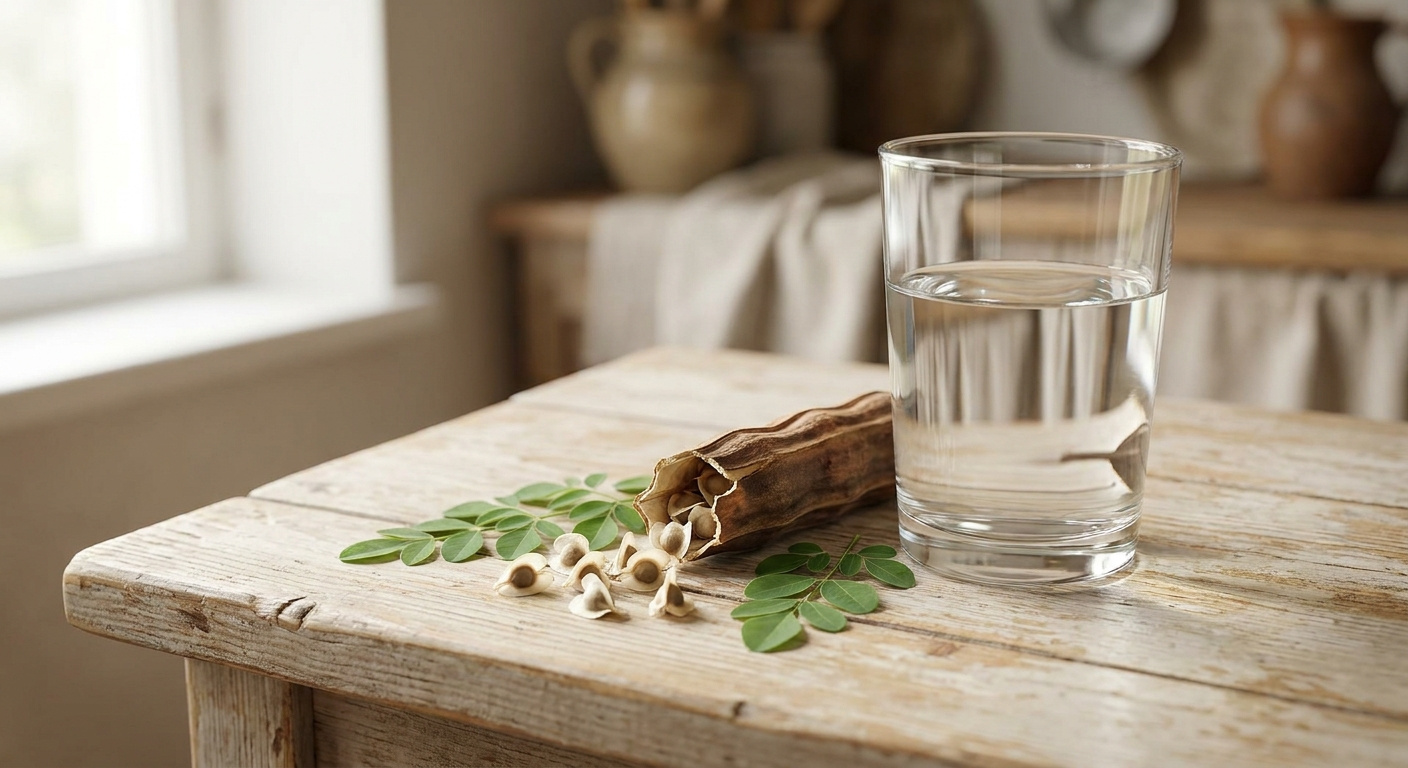
A new study published in the journal ACS ES&T Water adds an interesting wrinkle to that conversation. Researchers at São Paulo State University, working with collaborators at the University of Birmingham, tested whether seed extract from the Moringa oleifera tree — a tropical plant long used in low-income communities to clarify drinking water — could match the microplastic-removal performance of aluminium sulfate, the chemical coagulant used in most municipal water treatment plants worldwide, including Australia's.
The short answer: yes, it can.
What the researchers actually did
The team, led by environmental engineer Adriano dos Reis, ran a series of bench-scale tests using two filtration setups common in water treatment: direct filtration and in-line filtration. Both rely on a coagulant — a substance that makes tiny suspended particles clump together so a filter can catch them.
They spiked synthetic water samples with polyethylene microplastic particles, then treated each batch with one of two coagulants. The first was aluminium sulfate, better known as alum, which has been the workhorse of water treatment chemistry since the early twentieth century. The second was a water-soluble extract of crushed Moringa oleifera seeds, which contains a naturally occurring cationic protein that behaves much like a coagulant.
In direct filtration, both treatments achieved comparable microplastic removal rates. In in-line filtration — a more compact configuration sometimes used in smaller treatment plants — the Moringa extract held its own against alum, with removal efficiency in the same range across particle sizes.
The headline finding is not that Moringa is better than alum. It is that for microplastic removal specifically, a natural seed-derived coagulant performs at the same level as the chemical the world has been using for a century.
Why this matters for what comes out of your tap
Australian water utilities are among the best-resourced in the world. Sydney Water, Melbourne Water, Yarra Valley Water and their counterparts in every state and territory operate sophisticated multi-barrier treatment systems that include coagulation, flocculation, sedimentation, filtration and disinfection. Most use alum or a related aluminium-based coagulant as the first chemical step.
The Australian Drinking Water Guidelines, maintained by the National Health and Medical Research Council, set out limits for around two hundred substances. Microplastics are not currently among them. There is no national monitoring program that requires utilities to test for them, and there is no enforceable threshold.
That is not because anyone has decided microplastics are safe. It is because the science of what they actually do inside the human body is still in early stages, the methods for measuring them in water are still being standardised, and regulators move slowly while the evidence catches up.
The World Health Organization's most recent assessment, published in 2022, concluded that the health risks of microplastics in drinking water appear to be low based on currently available data — while explicitly noting that data is limited and that more research is urgently needed. The WHO recommended that water utilities focus on existing treatment processes that already remove most particles, including microplastics, rather than introducing new dedicated steps.
The Brazilian study is part of that wider effort to understand exactly how well existing processes do their job, and whether there are gentler alternatives.
The chemical question many parents already worry about
Alum works. It is also the substance that, decades ago, sparked questions about aluminium exposure and brain health — questions that have since been examined repeatedly by major health authorities including the National Health and Medical Research Council and the European Food Safety Authority. The current consensus is that aluminium from drinking water represents a small fraction of total dietary exposure for most people, and that levels in treated tap water are not considered a significant health risk.
That consensus has not stopped some Australian mums from quietly preferring filtered water at home, particularly during pregnancy or when preparing infant formula. The appeal of a plant-derived alternative is partly about reducing chemical inputs into the supply, and partly about communities that struggle to afford imported chemicals having a locally grown option.
For utilities operating in well-resourced economies like Australia, the immediate practical impact of a Moringa study is limited. No Australian utility is about to switch from alum tomorrow. But the research adds to a growing body of work suggesting that the way we treat water can evolve — and that natural coagulants might play a role alongside, or eventually instead of, chemical ones.
What you can actually do at home
Most of the advice that circulates online about microplastics is either alarmist or ineffective. Here is what the current evidence actually supports.
Filtration that helps
Activated carbon block filters — the kind found in many under-sink and pitcher-style systems — capture microplastic particles down to around one micron, which covers the majority of particles found in tap water. Look for filters certified to NSF/ANSI Standard 53 or 401. Basic granulated-carbon pitchers like entry-level Brita are less effective for microplastics; the solid carbon block versions are what you want.
Reverse osmosis systems remove microplastics extremely well, along with most other contaminants. They are more expensive to install and waste some water during operation, but for families who want maximum filtration this is the most thorough option.
Things that don't help much
Boiling water does not remove microplastics. Some research suggests it may help precipitate them out alongside calcium when the water is hard, but the effect is modest and inconsistent. Letting water sit in an open jug, freezing it, or running it through cloth do nothing meaningful.
Where most family microplastic exposure actually comes from
Drinking water is one source, but for most Australian families it is not the main one. Plastic food packaging, plastic-lined takeaway containers, microwaving food in plastic, and synthetic textiles shedding fibres into household dust are all larger contributors to overall exposure. Switching to glass or stainless steel for hot food and drinks tends to reduce daily exposure more than filtering tap water does.
If you breastfeed or prepare formula, the practical points are: use cool or room-temperature water for formula reconstitution where the manufacturer's instructions allow, avoid plastic kettles where possible, and consider stainless steel or glass bottles for older babies no longer drinking only breastmilk.
The bigger picture
What makes the Moringa research notable is not that it solves the microplastic problem. It does not. Removing plastic particles after they have entered the water supply is downstream treatment of a problem that begins much further upstream — with how much plastic the world manufactures, how it is used, and how it breaks down.
But studies like this one matter because they expand the toolkit. They suggest that water treatment, including the steps that already protect Australian families every day, can keep getting better. They show that a seed harvested from a tropical tree can do the work of an industrial chemical. And they remind us that the question of what is in our water — and what we can do about it — is one that families, scientists and regulators are still actively working out together.
For now, the most useful action most Australian families can take is the dullest one: install a properly certified carbon block filter on the tap or jug you use for drinking and cooking water, replace the cartridge on the recommended schedule, and stop worrying about the rest. Australian municipal water is treated to a high standard, and a good home filter handles most of what gets through.